Model of Neurological Levels
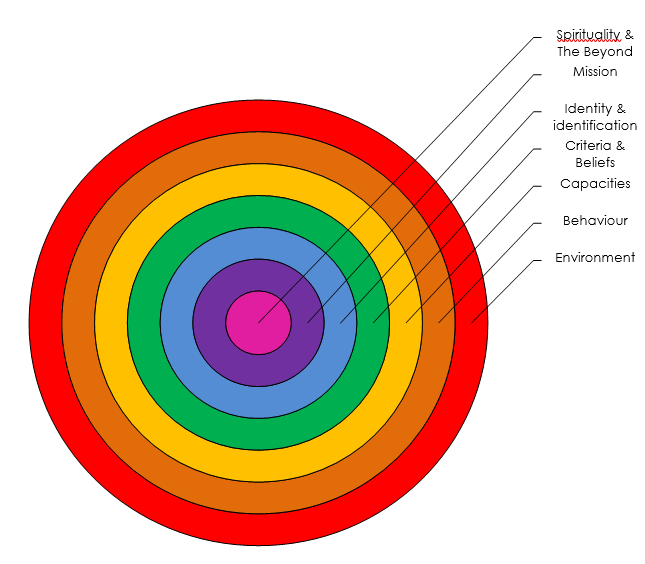
To find identifications it may help to use this model, developed by Robert Dilts, based on the work of Gregory Bateson, who dedicated his life to find answers on the question: “What is the pattern that connects the crab to the lobster and the primrose to the orchid, and all of them to me, and me to you?”
The model usually shared as a pyramid, outlines 6 logical levels that describe how people think, learn, change, communicate, and function.
Every person acts and thinks—consciously or unconsciously—on all six levels simultaneously.
In coaching and therapy it is used for many purposes.
Here, it shows the external and internal aspects of consciousness which can help us to map our identifications and show whether our behavior aligns with who we are.
This can be discovered by watching people, questioning and listening to how they use their words.
As you can see in the description, the level of Behavior is not only related to what we do, but also to mental and emotional activity. For that we made two separate pages:
discovering patterns in thinking en feeling. Links are at the end of this page.
The model of Neurological Levels:
Environment
Where (Space), When (time: date and hour if appropriate), with Whom and What?
Tells us about the context of our experiences and external limits and possibilities.
Example: “I am an American .”
Behavior:
What/how do we do or say? (about recordable (re)actions and functions)
Examples: “I am the janitor.“
Behavior is also related to our mental and emotional activity.
Example: “Je pense, donc je suis” (Descartes, 1637).
Capacities and skills:
How do we do it?
About qualities, talents, strategies, competence and know-how
Example: “I am a curious and serious person.”
Beliefs and Values:
What directs us in what we do?
What is important to/for us? What do we believe about ourselves, others, and the world?
N.B.:
Core-Beliefs are deeply hidden in our subconsciousness, stored in the memory system that exists before the development of conscious, autobiographical memories (which usually emerge around age 3-4). It s called implicit memory, opposite to the more consious explicit memory. Beliefs we develop when we are becoming more conscious about ourselves and the world, are often rooted in the core-beliefs.
Both type of beliefs are directing us on all levels and about what we confirm, about our motivation, and what is allowed or not.
Identity:
Who am I?
A question that moves behind the roles we may take on?
How do we see ourselves beyond the other levels?
Mostly here we will hear or read metaphors, because our real identity is indescribable (which is a belief of or true for the author of these texts).
Sometimes also used without this restriction and just ask for the roles one identifies him or herself with on one or more of the different levels.
Example: “I am a good trainer tells” about behavior and capacities.
Meaning/Mission:
What are we here for? What is our contribution to life? What do we consider to be our purpose in life?
Example: “I keep the fire going on.”
Spirituality & The Beyond
This level was later added to the original model, to investigate the way we see ourselves as belonging to the Whole.
Example: “I am a sannyasin.” “I am a child of the universe.”
Back to Resources
Back to Charaiveti, Charaiveti
Back to Charaiveti, Charaiveti – Mental Roadblocks
Discovering Identifications by Feeling & Emotions
Discovering Identifications by Thinking
Tips for Homework